Machine Learning for Beginners: What It Is, Types & Real-Life Examples
Machine learning means teaching a computer with examples, instead of writing every rule by hand.
Traditional code follows human rules. ML code learns rules from data.
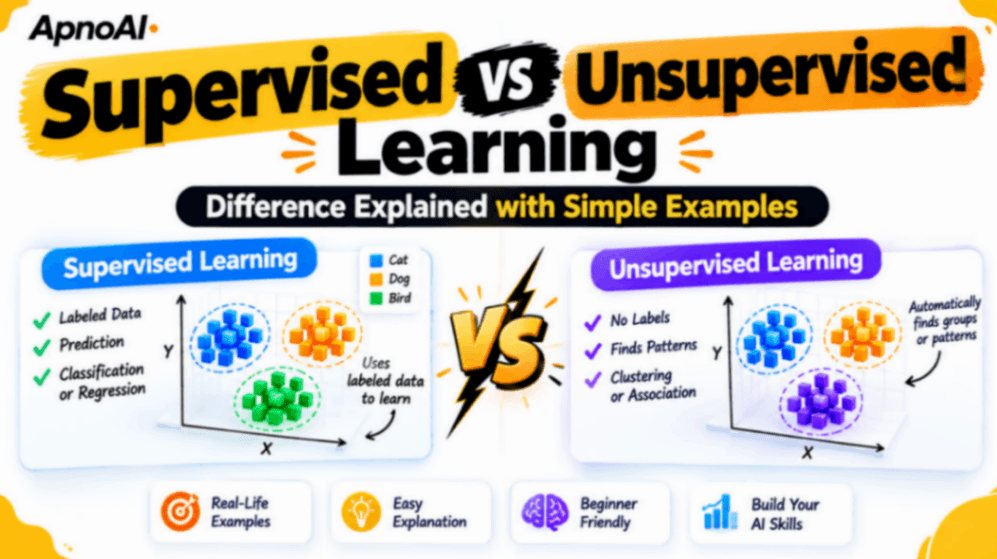
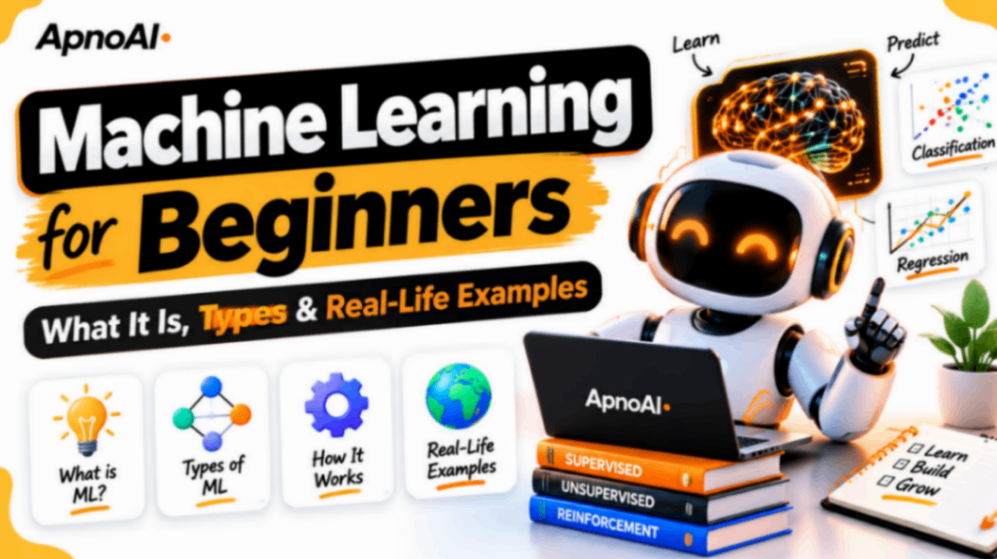
There are three main types: supervised (learn with answers), unsupervised (find patterns without answers), and reinforcement (learn by reward and penalty).
You already meet ML dozens of times daily: spam filters, recommendations, fraud alerts, photo search.
No maths fear needed here. This guide builds intuition first, formulas later.
Team note: In college, machine learning was taught to us as a wall of formulas on day one. We understood it only later, through examples. This guide is the version we wish someone had given us: intuition first, maths when you are ready for it.
What Is Machine Learning, Without the Jargon?
Think about how a child learns what a cat is. Nobody gives the child a definition like “a small carnivorous mammal with retractable claws”. The child sees cats. Many cats. Big cats, small cats, black cats, sleepy cats. And slowly, the child’s brain builds the pattern itself.
Machine learning is exactly this, but for computers. Instead of programming every rule by hand, we show the computer many examples, and let it find the pattern itself.
Machine learning is teaching a computer with examples, instead of rules.
Traditional Code vs ML Code: The Real Difference
Look at the same problem solved both ways. Spot the difference in who writes the rules:
# Traditional programming
# Human writes the rules
rules = human_writes_rules()
answer = rules(input)
# Machine learning
# Machine learns the rules from examples
examples = many (input, correct_answer) pairs
model = learn(examples)
answer = model(new_input)
In traditional code, a human must know every rule. That works for simple problems. But try writing rules to recognize your friend’s face in a photo, or to detect a fraudulent UPI transaction. The rules are too many, too fuzzy, too changing. That is where ML wins: the machine extracts the rules from thousands of examples.
In real code, that last line often looks something like model.predict(new_email). One clean line, with thousands of learned patterns hiding behind it.
A Real Example You Already Use: The Spam Filter
Your email app separates spam from real mail every day. Nobody wrote a rule list for every scam sentence in the world. Here is what actually happened behind it:
Millions of emails were collected
Humans marked them: spam or not spam (these marks are called labels)
The model studied patterns: words like “lottery”, “urgent prize”, strange links
Now it predicts for every new email: spam or inbox
When you mark something wrong as spam, the model learns from that mistake
Intuition check: if you can teach a child something by showing examples, a machine can probably learn it the supervised way. If even you cannot write the rules clearly, that is a strong hint ML is the right tool.
The Three Main Types of Machine Learning
Every ML system you will ever meet fits into one of these three families. Learn these well and half of ML interviews become easy conversation.
1. Supervised Learning: Learning With Answer Keys
The model trains on data that already contains the correct answers, like a student practicing from a solved question bank. Each training example is a pair: input plus correct output.
Email text → spam or not spam
House size and location → predicted price
X-ray image → healthy or needs attention
2. Unsupervised Learning: Finding Patterns Without Answers
Here there are no labels, no answer key. The model simply studies raw data and finds structure on its own, like sorting a mixed pile of objects into groups by similarity.
Grouping shoppers into segments by buying behavior
Finding unusual transactions that look different from the rest
Organizing thousands of documents into topic clusters
3. Reinforcement Learning: Learning by Reward and Penalty
The model acts, gets rewarded for good moves and penalized for bad ones, and improves over thousands of attempts. Exactly like training a puppy with treats, or like how you learned to ride a bicycle by falling.
Game AI learning to win by playing itself millions of times
Robots learning to walk without breaking
Recommendation systems tuning what to show next based on your clicks
Type | What the Model Gets | Real-Life Example |
Supervised | Inputs with correct answers (labels) | Spam filter, price prediction |
Unsupervised | Only raw data, no answers | Customer grouping, anomaly patterns |
Reinforcement | Rewards and penalties for actions | Game AI, robot movement |
ML vs AI vs Deep Learning: Clearing the Confusion
These three terms get used like synonyms online, but they are nested boxes, not equals:
AI (Artificial Intelligence): the big box. Any technique that makes machines behave smartly, even old rule-based systems.
Machine Learning: a box inside AI. Systems that learn from data instead of hardcoded rules.
Deep Learning: a box inside ML. ML using large neural networks, especially strong with images, audio, and text.
Honest truth: ML is not magic. It is pattern-finding at scale. Feed it garbage data and it will confidently learn garbage. The model is only as good as the examples you give it.
So far you know what ML is, how it differs from traditional code, its three families, and where it sits inside AI. In the next part we open the engine: the exact step-by-step workflow every ML model follows, the ML hiding in your daily life, the myths that confuse beginners, and a clear roadmap to start learning it properly.
How an ML Model Actually Learns: The Real Workflow
Every machine learning project, from a college mini project to a industry system, follows roughly the same seven-step loop. Memorize this loop and you will never feel lost in any ML article again.
flowchart TD
    A[Collect Data] --> B[Clean Data]
    B --> C[Split: Train + Test]
    C --> D[Train Model]
    D --> E[Evaluate on Test]
    E --> F{Good Enough?}
    F -->|No| D
    F -->|Yes| G[Predict on New Data]
Collect data: gather examples, like sales records, emails, or images.
Clean data: fix duplicates, missing values, and wrong entries. Yes, the data cleaning you already learned is step two of ML.
Split data: keep one part hidden for testing, like keeping an unseen exam paper aside.
Train: the model studies the training part and finds patterns.
Evaluate: test it on the hidden part it never saw during practice.
Improve: if results are weak, fix data or settings and train again.
Predict: finally use the model on fresh, real-world inputs.
The exam analogy: the train-test split is exactly like practicing with old question papers and then sitting for a new exam. If a model only sees practice papers and is graded on the same papers, its “99% score” means nothing. In code, this split is often one line like train_test_split(data).
Machine Learning Is Already All Around You
You are not “starting ML from zero”. You have been using ML products for years. Look at how many touch your daily life:
Where You See It | The ML Job Inside |
Email app | Spam vs inbox classification |
Shopping apps | “People like you also bought” recommendations |
Banking apps | Fraud transaction alerts in seconds |
Phone gallery | Face grouping and photo search |
Maps | Traffic-aware arrival time prediction |
Music and video apps | Next song or next video suggestions |
Notice a pattern: none of these feel like “AI magic”. They feel like convenience. That is what good machine learning looks like in real life — invisible, useful, and quietly wrong sometimes.
The Eight Words You Will Hear Everywhere
Before you read any other ML article or watch any course, own these eight terms. Everything else is built on them:
Term | Plain Meaning |
Dataset | The table or collection of examples the model learns from |
Label | The correct answer in a training example |
Feature | An input column the model uses, like size or location |
Model | The learned pattern, saved and reusable |
Training | The studying phase on training data |
Prediction | The model’s answer on new, unseen input |
Overfitting | Memorizing practice data instead of learning patterns |
Train-test split | Keeping unseen data aside to grade the model honestly |
Five Myths That Confuse Every Beginner
Myth 1: ML Means the Machine Thinks Like a Human
It does not think. It finds statistical patterns. A spam filter has no idea what money or fraud means; it only knows certain word patterns appear more in spam.
Myth 2: You Need Advanced Maths on Day One
You need comfort with basic statistics eventually, but your first working model needs logic and clean data more than calculus. Maths becomes meaningful after you have built something.
Myth 3: More Data Is Always Better
More relevant and clean data helps. More garbage data just teaches garbage faster. Coverage matters too: a model trained only on weekday sales will fail badly on festivals.
Myth 4: ML Models Are Neutral and Fair
Models learn from human data, and human data carries human bias. A hiring model trained on biased history can repeat that bias confidently. Fairness is a design responsibility, not an automatic property.
Myth 5: You Need a Supercomputer to Start
Your first hundred models will run happily on a normal laptop, or free browser tools. GPUs matter later, for deep learning at scale, not for learning the basics.
Beginner Mistakes That Waste Months
Mistake | Result | Fix |
Skipping the train-test split | Fake confidence, real-world failure | Always hold out unseen test data |
Ignoring data cleaning | Garbage in, confident garbage out | Clean before you train, always |
Copying code without understanding | Works once, never again | Type it, break it, fix it yourself |
Chasing the fanciest model first | Confusion without fundamentals | Master simple models before neural nets |
Never evaluating honestly | No idea if the model actually works | Measure on unseen data, every time |
Your Machine Learning Roadmap: What to Learn, In What Order
Do not collect ten courses. Follow one order, build as you go:
Python Basics
Variables, loops, functions.
Data Handling
Pandas and cleaning skills.
Core ML
Simple models with scikit-learn.
Evaluation
Splits, errors, overfitting.
First Project
One end-to-end build.
Deep Dive
Deep learning and LLMs later.
Try this today, no install needed: design a supervised model for our Chai & Code Cafe on paper. What are the inputs (features)? Maybe day of week, weather, and festival flag. What is the label? Cups sold. If you can write those two lists correctly, you have just done the hardest thinking part of machine learning.
🎯 Key Takeaways
ine learning teaches computers with examples instead of hand-written rules.
Supervised learns with labels, unsupervised finds hidden structure, reinforcement learns from reward and penalty.
AI is the big box, ML sits inside it, deep learning sits inside ML.
Every ML project follows the same loop: collect, clean, split, train, evaluate, improve, predict.
The train-test split is your honesty check; without it, scores are meaningless.
Overfitting is memorization, not learning, and it is the most common beginner trap.
You already use ML daily in email, maps, banking, and recommendations.
Start with Python and data handling; fancy models can wait their turn.
Conclusion
Let us end with an honest story. Our very first ML model was a tiny chai-sales predictor, built with great pride. It confidently told us sales would be zero on every Sunday. We panicked, checked the code for hours, and finally looked at the data: the shop was closed on Sundays, so no Sunday rows existed at all. The model was not stupid. Our data had a blind spot, and the model faithfully learned that blindness.
That single moment taught us more than any course certificate: machine learning mirrors the data you give it, including its silences. Every wrong prediction you will ever debug usually leads back to the data, not the algorithm.
So start small. Understand the three types. Respect the workflow. Clean your data like it owes you money. And build one tiny end-to-end model this week, even if it is as silly as predicting chai sales. Because the distance between “I read about ML” and “I built an ML model” is exactly one small project.
A model is only as wise as the examples it was raised on. Raise it well.
When you are ready for the next step, the supervised vs unsupervised deep dive and the LLM explainers on this blog continue this exact journey, in the same plain language. And if you want these steps checked by a mentor while you build, our AI/ML and Data Analytics internship tracks run on this same workflow, project by project.
Thank you for learning with us. If this guide made ML feel smaller and closer than it did ten minutes ago, share it with a friend who is still scared of the word “algorithm”. — Harsh Mishra, APNOAI Team