Supervised vs Unsupervised Learning: Difference Explained with Simple Examples
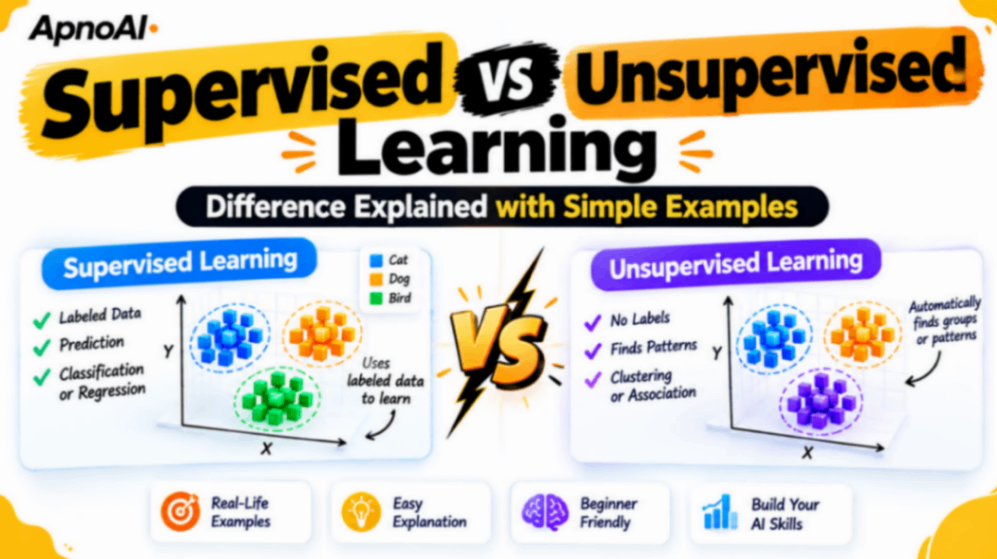
Supervised learning trains on labeled data: input plus the correct answer, like a teacher watching over you.
Unsupervised learning trains on unlabeled data: no answers given, the model must find structure on its own.
Supervised splits into classification and regression. Unsupervised splits into clustering, association, and dimensionality reduction.
Spam filters and price prediction are supervised. Customer grouping and recommendation patterns are unsupervised.
This guide is written exam-first: syllabus definitions, point-to-point differences, and the comparison table examiners expect.
Team note: We lost marks on this exact question in our own semester exam. The definition was correct, but we gave a supervised example under an unsupervised heading. The examiner cut marks only for the example. That is why this article gives examples more weight than definitions, because that is where marks actually live.
Where These Two Sit in Machine Learning
Before the definitions, one quick map. Machine learning has three main families: supervised, unsupervised, and reinforcement. Today we compare the first two, because they cover the vast majority of real industry work and almost every university exam question.
The simplest mental image: supervised learning is a student studying with a solved answer key. Unsupervised learning is a student given raw question papers with no answers, asked to find patterns and groupings alone.
Supervised Learning: The Syllabus Definition
Supervised learning is a machine learning technique in which the model is trained on a labeled dataset, where each input example is paired with its correct output. The model learns a mapping from inputs to outputs and uses it to predict results for new, unseen data.
Now the same definition in point-to-point form, the way you would write it in an exam:
Labeled data: every training example has input features and a correct answer (label).
Direct supervision: during training, the model’s guess is compared with the true answer, and errors correct it.
Goal: learn a mapping function so unseen inputs get correct predicted outputs.
Clear evaluation: because true answers exist, accuracy can be measured honestly.
The Two Subtypes Examiners Always Ask
Classification: the output is a category. Spam or not spam. Healthy or sick. Cat or dog.
Regression: the output is a continuous number. House price, temperature, sales quantity.
See the difference in output type: categories versus numbers. Half of all supervised exam questions are just identifying which subtype a problem belongs to.
# Labeled data: input + correct answer
X = [house sizes, locations, ages...]
y = [actual sold prices...]
model = train(X, y)
price = model.predict(new_house)
# Unlabeled data: only inputs, no answers
X = [customer purchase patterns...]
groups = cluster(X)
# model discovers the groups by itself
A Supervised Example You Own: Your Spam Folder
Open your email right now and look at the spam tab. Every mail sitting there was classified by a supervised model. How did it learn? Humans labeled millions of emails as spam or not spam, the model trained on those pairs, and now it predicts for each new mail.
.
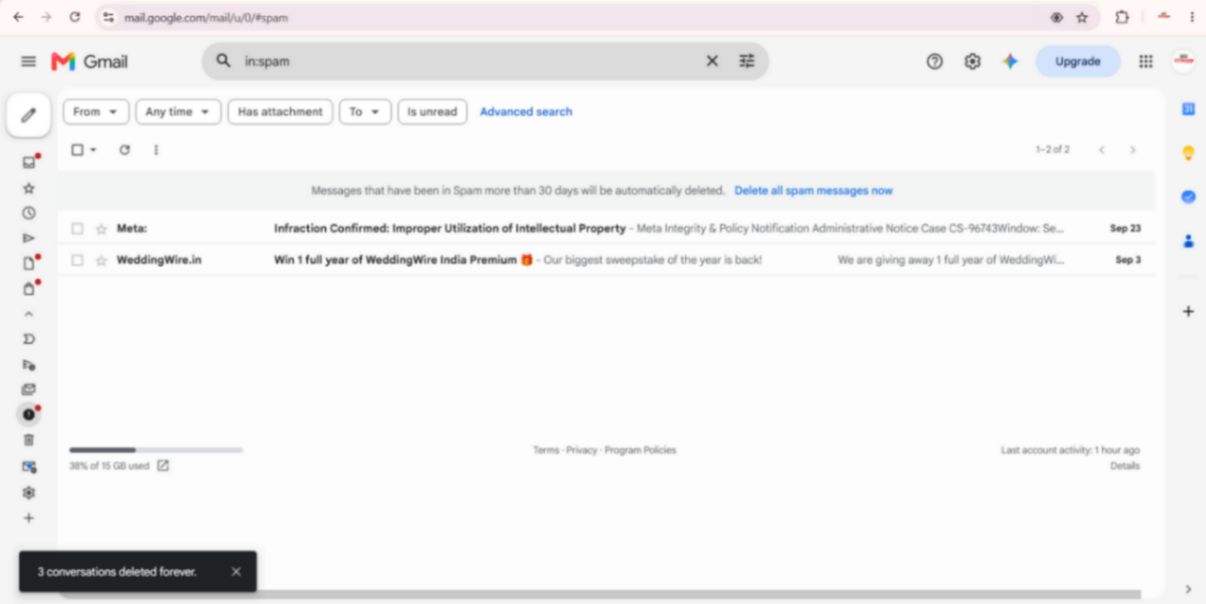
More syllabus-standard supervised examples: house price prediction (regression), disease diagnosis from reports (classification), loan approval prediction (classification), and marks prediction from study hours (regression).
Unsupervised Learning: The Syllabus Definition
Unsupervised learning is a machine learning technique in which the model is trained on unlabeled data with no predefined outputs. The model explores the data on its own and discovers hidden patterns, structures, or groups without any teacher correcting it.
Point-to-point, exam style:
Unlabeled data: only inputs are given; no correct answers exist in the dataset.
No supervision: nobody tells the model whether it is right during training.
Goal: discover hidden structure: groups, associations, or simpler representations.
Harder evaluation: with no true answers, “correctness” is often judged by usefulness, not accuracy.
The Subtypes You Must Name in Exams
Clustering: grouping similar items, like customers with similar buying habits.
Association: finding items that occur together, like “people who bought chips also bought cold drink”.
Dimensionality reduction: compressing many columns into fewer while keeping the important information.
An Unsupervised Example You Have Already Clicked
When a shopping app shows “similar items” or groups products into styles nobody manually tagged, that is unsupervised pattern-finding at work. The app studied millions of purchase patterns and discovered which items behave alike, without anyone labeling them.
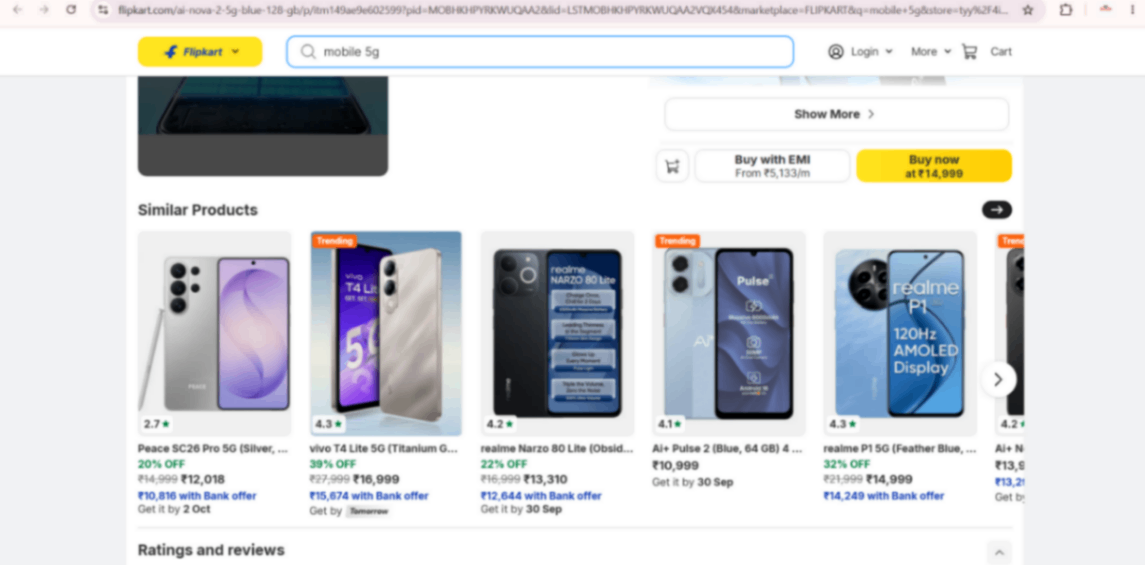
More syllabus-standard unsupervised examples: customer segmentation for marketing, anomaly grouping in network traffic, face grouping in phone galleries, and market basket analysis in supermarkets.
The Comparison Table Examiners Expect
This exact table format is what scores full marks in theory papers. Write it column by column, not in paragraphs:
Point | Supervised Learning | Unsupervised Learning |
Training data | Labeled (input + output) | Unlabeled (input only) |
Supervision | Like learning with a teacher | Like learning alone, no teacher |
Main goal | Predict output for new input | Find hidden structure or groups |
Subtypes | Classification, regression | Clustering, association, dimensionality reduction |
Feedback | Direct, compared with true label | None during training |
Accuracy measurement | Easy and honest | Difficult, often subjective |
Typical examples | Spam filter, price prediction, diagnosis | Customer segmentation, market basket, face grouping |
One-line exam answer | Learning with labeled answers | Learning structure without answers |
The mark-killer we personally suffered: giving “recommendation” as a supervised example. Recommendations can use both types depending on design, so in exams use unambiguous examples: spam filter for supervised, customer segmentation for unsupervised. Safe examples save marks.
Definitions done, subtypes done, examples done, comparison table done. But exams and interviews go one level deeper: classification vs regression identification, choosing the right type for a new problem, and the tricky middle ground called semi-supervised learning. That is exactly what the next part covers, along with interview questions and the mistakes checklist.
Classification vs Regression: Identify It in Ten Seconds
Most supervised questions in exams and interviews are actually subtype questions in disguise. They describe a problem and ask which technique fits. The ten-second trick is one question only:
Is the answer a category, or a number? Category means classification. Number means regression.
Run the trick on these real problem statements and watch how fast they solve themselves:
Problem Statement | Output Type | Subtype |
Will it rain tomorrow? | Category (yes / no) | Classification |
What will tomorrow’s temperature be? | Number (degrees) | Regression |
Is this email spam? | Category (spam / not) | Classification |
What price will this house sell at? | Number (rupees) | Regression |
Which existing plan suits this customer? (plans predefined, past choices labeled) | Category (plan name) | Classification |
Discover unknown customer groups from raw purchases (no predefined groups) | No labels at all | Unsupervised clustering |
Read the last row twice: the same business goal, “group customers”, can be classification or clustering depending on one thing only — whether labeled groups already exist. This single nuance separates average answers from top-scorer answers.
Which Type Should You Use? The Decision Flow
When a brand-new problem lands on your desk, do not guess. Walk this flow, exactly in this order:
flowchart TD
    A[New Problem] --> B{Labeled Data Available?}
    B -->|Yes| C{Answer: Category or Number?}
    C -->|Category| D[Classification]
    C -->|Number| E[Regression]
    B -->|No| F{Goal: Groups or Patterns?}
    F -->|Yes| G[Unsupervised: Clustering or Association]
    F -->|No, learns from reward| H[Reinforcement Learning]
Notice that the very first question is not about algorithms at all. It is about data: do labels exist? In real projects, data availability chooses the method more often than personal preference does.
The Middle Ground: Semi-Supervised Learning
Syllabus bonus point, and a real industry favorite. Semi-supervised learning trains on a small amount of labeled data plus a large amount of unlabeled data.
Why does this exist? Because labels are expensive. Getting a doctor to label ten thousand X-ray images costs serious time and money. But hospitals already have millions of unlabeled images sitting on servers. Semi-supervised methods use the few labeled examples as anchors and let the unlabeled majority sharpen the patterns.
Use it when: labeling is costly but unlabeled data is abundant.
Common examples: medical imaging, web page classification, speech recognition.
A weekend we never forgot: we once spent an entire Saturday labeling five hundred photos for a small project, eyes burning by evening. That was the day semi-supervised learning stopped being a syllabus term and became a personal necessity. If labeling hurts, you now understand why this field exists.
Real Problems Beginners Actually Face (And Their Fixes)
Theory is clean. Practice is messy. These are the problems that show up in real projects and in exam answer sheets, with the fixes we use ourselves:
Problem | Why It Happens | Fix |
Supervised example written under an unsupervised question | Examples memorized without checking the label condition | Before writing any example, ask: were labels given? |
Calling every recommendation system supervised | Real systems mix both types internally | In exams use unambiguous examples instead |
Answer without naming subtypes | Definition written, structure skipped | Always name classification/regression or clustering/association |
Assuming unsupervised means “no evaluation needed” | No labels feels like no grading | Evaluate with cluster quality checks and business usefulness |
Label leakage: answer information hiding inside features | A column secretly encodes the target | Inspect every feature before training; doubt 99% accuracy |
Imbalanced labels: one class dominates the data | Model learns “always guess majority” | Use proper metrics and balancing techniques, not plain accuracy |
Interview Questions Students Actually Get
1. Give one-line definitions of supervised and unsupervised learning.
Supervised: learning from labeled data with input-output pairs. Unsupervised: learning structure from unlabeled data without given outputs. Say both in one breath each; interviewers reward crispness.
2. Is clustering supervised or unsupervised, and why?
Unsupervised, because no predefined labels exist. The model discovers groups purely from similarity in the data.
3. Name two regression problems you see in daily life.
House price prediction and temperature forecasting. Both output continuous numbers, which is the regression signature.
4. Why is evaluating unsupervised models harder?
Because there is no correct answer key to compare against. Quality is judged by cluster cohesion, domain sense, and whether the result is actually useful downstream.
5. What is semi-supervised learning in one sentence?
Training with a small labeled set plus a large unlabeled set, used when labeling is expensive but raw data is plentiful.
6. A dataset has inputs but the client does not know what groups exist. What do you propose?
Start with unsupervised clustering to reveal candidate groups, then let the business name them, and only later move to supervised models if prediction on those groups is needed. This answer shows process thinking, not memorization.
Five-Question Practice Set (Exam Style)
Try these on paper before scrolling to the key. Each is one line, exactly like viva questions:
Predicting whether a loan applicant will default: which type and subtype?
Grouping unlabeled news articles by topic: which type?
Predicting next month’s total sales in rupees: which subtype?
Finding products frequently bought together: which unsupervised subtype?
Training with 200 labeled images and 20,000 unlabeled images: which approach?
Answer key: 1) Supervised, classification. 2) Unsupervised, clustering. 3) Regression. 4) Association. 5) Semi-supervised learning. If you got all five, this topic is exam-ready.
Supervised learns from labeled pairs; unsupervised finds structure in unlabeled data.
Category output means classification; number output means regression.
The same business goal can be classification or clustering depending on whether labels exist.
Unsupervised subtypes are clustering, association, and dimensionality reduction.
Semi-supervised exists because labeling is expensive and raw data is cheap.
The first decision in any ML problem is data: do labels exist?
Unsupervised still needs evaluation, just without an answer key.
In exams, safe unambiguous examples score more than impressive risky ones.
Conclusion
Supervised and unsupervised learning are not two random chapters to memorize. They are two answers to one question: do we already know the answers, or must we discover the structure? Every ML system you will ever build starts by answering that question honestly.
Remember our exam story from the first part: definitions rarely lose marks, examples do. So before writing any example in any paper, pause for two seconds and ask whether labels existed. That tiny pause is worth more than an extra page of theory.
And when you sit in an interview and they slide a vague problem statement across the table, do not rush to name an algorithm. Name the data first. Labels or no labels, category or number, groups or rewards. The method will then choose itself, and you will sound like someone who has actually built things, because now, in a small way, you have.
Labels decide the method. Clarity decides the marks. Practice decides the job.
Continue the journey with the machine learning basics guide if you are new here, or move on to the LLM explainer next, where supervised learning meets modern language models. Both are written in this same plain language, for the same reason: you deserve explanations that respect your time.
Thank you for studying with us. If this comparison table saves you even one mark in one exam, it did its job. Share it with a batchmate the night before the paper. — Harsh Mishra, APNOAI Team