What Is an LLM? How Large Language Models Work in Simple Words
An LLM is a system trained on enormous amounts of text that learns to predict the next word, again and again, until a full answer appears.
It does not look up facts in a database. It writes word by word using patterns learned during training.
It reads text in pieces called tokens, not in whole words or sentences.
Training happens in stages: pretraining on raw text, instruction tuning, then alignment with human feedback.
Because it predicts probabilities, the same question can produce slightly different answers twice. That is normal, not a bug.
And because it predicts instead of retrieving, it can sound confidently wrong. That failure mode has a name: hallucination.
Team note: We first understood LLMs not from a research paper, but at a dinner table, trying to explain to our parents why the phone assistant could write a poem but could not reliably tell them yesterday’s cricket score. That confusion, “so smart yet so wrong”, is exactly what this article explains properly.
You Have Already Talked to an LLM
If you have ever asked ChatGPT to write an email, Gemini to summarize notes, or a coding assistant to fix your error, you have used a large language model. Billions of people now talk to these systems daily, yet most explanations online either drown beginners in mathematics or wave hands and say “it is magic”.
Neither is true. The truth is simpler and stranger than both: an LLM is, at its core, an extremely good next-word guesser. Everything impressive it does grows out of that one humble skill, repeated millions of times.
The Definition, Unpacked Word by Word
A large language model is a machine learning system trained on a huge amount of text, which learns statistical patterns of language so well that it can predict the next word in a sentence, and through that single skill, can write, summarize, translate, explain, and answer questions.
Now open the term itself like a box and look at each word inside:
Word | What It Actually Means |
Large | Enormous training text and billions of internal parameters (learned knobs) |
Language | Works on text; modern ones also handle images and audio (multimodal) |
Model | The saved learned patterns, a file of tuned numbers, not a program with rules |
Notice what is missing from this definition: databases, search engines, rule books. An LLM is none of those. It is a pattern machine.
The Core Trick: Predicting the Next Word
Look at an incomplete sentence and let your own brain do what an LLM does:
“The customer walked into the cafe and ordered a hot cup of ___”
Your mind instantly offered candidates, probably with feelings of likelihood:
chai — very likely, especially in India
coffee — also likely
tea — possible
socket — technically a word, practically nonsense here
That is the entire engine. An LLM assigns probabilities to every possible next piece of text, picks one, appends it, and then repeats the process on the new, longer sentence. Word by word, a paragraph appears. There is no hidden library inside; there is only a very well-trained sense of “what usually comes next”.
text = your_prompt
repeat many times:
    probs = model.predict_next_piece(text)
    next_piece = choose(probs)   # slightly random on purpose
    text = text + next_piece
return text
Why the Same Question Gives Different Answers
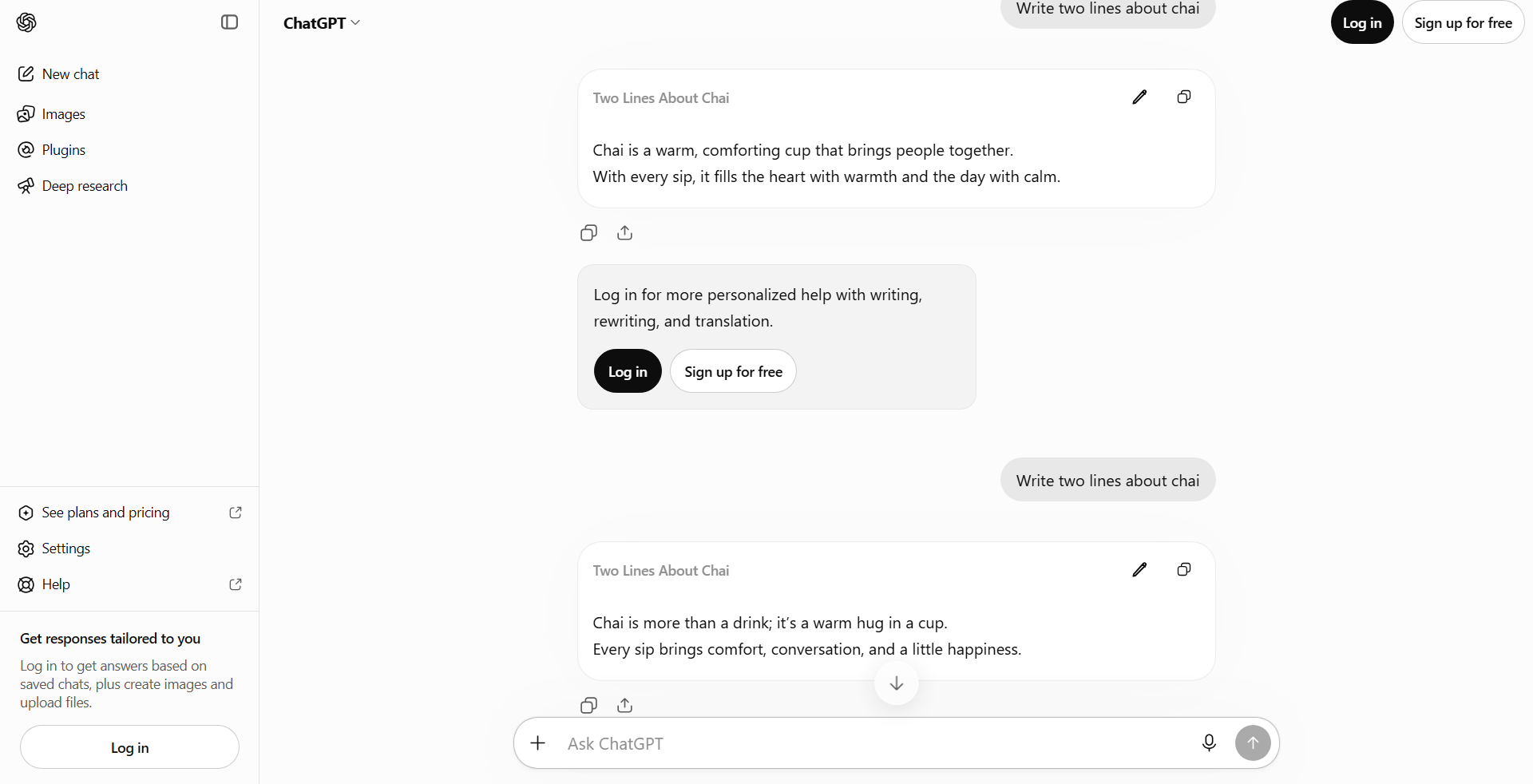
Look closely at the line marked “slightly random on purpose”. During generation, the model does not always take the top-probability word; a setting called temperature adds controlled randomness so answers do not feel robotic and identical every time.
That is why asking the same question twice can give two answers with different wording but the same meaning. Try it yourself right now with any chatbot. It is not moodiness. It is probability doing its job.
Tokens: How an LLM Actually Reads Your Text
An LLM does not read words the way you do. It reads tokens, which are chunks of characters. Common words often become one token, while longer or rarer words split into pieces.
Text | Roughly How It Splits |
chai | 1 token |
machine learning | 2 tokens |
unbelievable | pieces like un + believ + able |
a rare name or code snippet | many small pieces |
Why should a beginner care about tokens? For three practical reasons: models have a context window (a limit on how many tokens they can hold in one conversation), pricing is usually per token, and strange model mistakes with spelling or counting letters often happen because the model never “saw” the word as one unit.
Try this party trick: ask an LLM how many times the letter “r” appears in “strawberry”. Many models answer wrong the first time. Not because they cannot count in general, but because they see tokens, not letters. It is the cleanest demo of tokenization we know.
How an LLM Is Trained: Three Stages
Nobody sits and teaches the model facts one by one. Training happens in stages, each with a different job:
flowchart TD
    A[Stage 1: Pretraining on huge raw text] --> B[Stage 2: Instruction tuning]
    B --> C[Stage 3: Alignment with human feedback]
    C --> D[The chat model you talk to]
    D --> E[Your prompt arrives]
    E --> F[Next-token prediction repeats]
    F --> G[Answer appears piece by piece]
Stage 1: Pretraining — Reading Almost Everything
The model reads a colossal amount of text: books, articles, code, public web pages. The task is simply next-word prediction, over and over, billions of times. Here is a beautiful connection to our earlier guide: this stage is self-supervised. The “label” is free, because the next word in any sentence is already known. No human labeling army needed, which is why training can scale so enormously.
Stage 2: Instruction Tuning — Learning to Behave Like an Assistant
A raw pretrained model is a text-continuer, not a helper. Ask it “What is photosynthesis?” and it might continue with more questions instead of answering. Instruction tuning trains it on examples of instructions paired with helpful responses, so it learns the behavior of answering, summarizing, and following requests.
Stage 3: Alignment — Learning to Be Safe and Useful
Finally, human feedback shapes the model: which of two answers is more helpful, more honest, more safe. This stage, often using reinforcement learning from human feedback (RLHF), is why modern assistants refuse harmful requests and prefer polite, structured replies over chaotic text dumps.
Scale reality check: pretraining a frontier model takes months on thousands of specialized chips and costs more than most houses. Using one, meanwhile, can cost less than a cup of chai per conversation. That gap between training cost and usage cost is why this technology spread faster than almost anything before it.
What an LLM Is NOT (The Myths That Cause Bad Decisions)
Not a database: it does not fetch stored facts; it regenerates plausible text. This is exactly why hallucinations happen.
Not a search engine: unless connected to tools, it cannot check today’s news or your private files.
Not a human mind: it has no beliefs, no understanding of truth, only extremely refined pattern sense.
Not up to date by default: its knowledge freezes at training cutoff unless tools feed it fresh information.
You now know what an LLM is, how it reads (tokens), how it writes (next-token prediction with a pinch of randomness), and how it is built (three training stages). The next part goes deeper into the consequences: why hallucinations happen, what a context window really limits, why prompts change answers so much, the honest limits table, and how to use LLMs like a professional instead of a magic box.
Hallucinations: When the Model Sounds Confidently Wrong
Now we reach the most important consequence of next-token prediction. Because an LLM generates plausible text instead of retrieving verified facts, it can produce statements that are smooth, detailed, and completely false. This failure mode is called a hallucination.
Understand why it happens and it stops being mysterious. The model is answering “what text usually follows this pattern?”, not “what is true?”. For a question about a rare court case, a small town, or an obscure paper, the most probable-sounding text and the true text can be different things, and the model has no internal mechanism to notice the gap.
Invented references and citations that look perfectly formatted but do not exist
Confident wrong dates, numbers, and names for uncommon topics
Fictional events described with realistic detail when asked leading questions
The dinner table lesson: the model that wrote our parents a lovely poem about chai also confidently told them a cricket score that never happened. Same model, same confidence. That is the rule to live by: trust LLMs for structure, language, and ideas; verify them for facts, numbers, and citations. Always.
Professional users do not avoid hallucinations by hoping. They manage them: cross-check important facts, ask the model to quote sources and then check those sources actually exist, and connect the model to real data through tools and retrieval instead of its memory.
Context Window: The Model’s Fixed-Size Whiteboard
Every LLM conversation happens inside a context window: a limit on how many tokens the model can hold in mind at once, including your messages and its replies. Think of it as a whiteboard of fixed size. New text keeps getting written, and when the board fills, the oldest writing gets erased.
This explains the most common user complaint: “It was following my rules an hour ago, now it forgets them.” Nothing broke. The early instructions simply slid off the whiteboard.
Long chats degrade quietly; important early details get forgotten first
Very large documents cannot be pasted in fully; they must be chunked or summarized
Starting a fresh chat for a fresh task often beats continuing a giant one
Pro habit: in long working sessions, restate your key rules every few messages, or keep a short “master prompt” you paste again when the model drifts. It feels silly and works brilliantly.
Why Your Prompt Changes Everything
Remember the generation loop: the model predicts what comes next after the text it has seen. Your prompt is that starting text. Change the start, and you change the entire probability landscape of what follows. This is not psychology; it is mechanics.
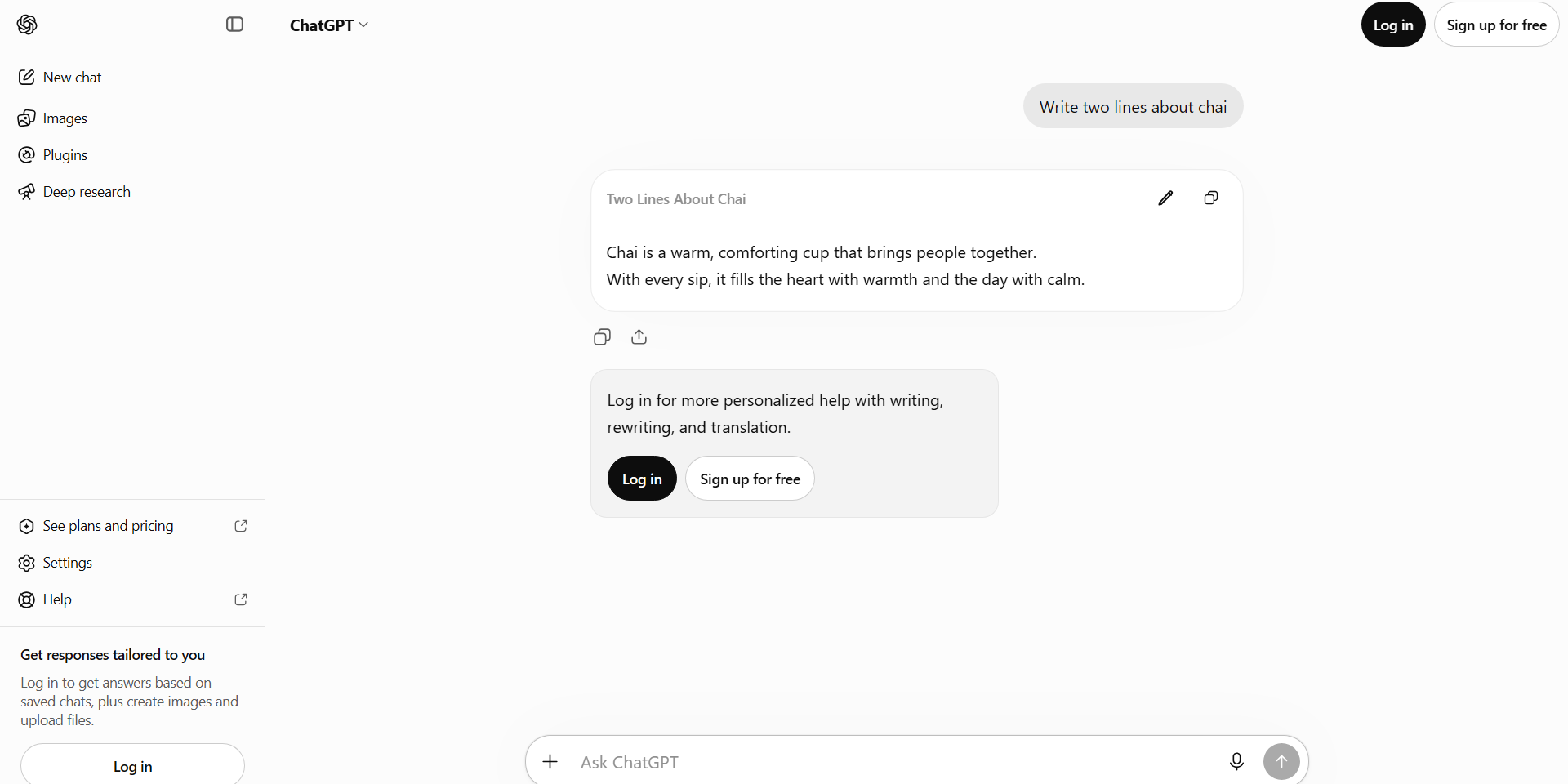
Write about chai.
You are a friendly cafe owner in Bhopal.
Write 5 short lines for a menu board about masala chai.
Tone: warm and playful. Audience: college students.
End with one line inviting people to try it today.
Both prompts reach the same model. The outputs will feel like they came from different universes, because the second prompt narrows role, format, tone, audience, and ending. The model is not being obedient; it is simply continuing a much more specific story. Our full prompt engineering guide on this blog builds this skill step by step.
LLM vs Traditional Software: A Honest Comparison
Point | Traditional Software | Large Language Model |
Behavior | Deterministic: same input, same output | Probabilistic: same input, similar but varying output |
Knowledge lives in | Code and databases | Learned patterns from training data |
Failure style | Loud: errors, crashes, clear messages | Silent: smooth, confident wrong answers |
Getting new knowledge | Update the database or code | Retrain, or connect tools and retrieval (RAG) |
Best at | Exact, repeatable rules and calculations | Language, summarization, drafting, explanation |
Notice the failure-style row carefully. A traditional program crashes loudly and tells you. An LLM fails silently and politely. That single difference is why professionals double-check model output on anything that matters.
The Honest Limits Table
Limit | What It Looks Like | Workaround |
Hallucination | Confident false facts and fake citations | Verify facts; use retrieval and tools |
Knowledge cutoff | Unaware of recent events by default | Use models with live search or feed fresh data |
Context window | Forgets early parts of very long chats | Restate key rules; start fresh chats per task |
Exact arithmetic and letter counting | Silly mistakes on simple counting tasks | Let code or calculators do exact maths |
Bias from training data | Stereotypes and skewed defaults surface | Review outputs critically, especially about people |
Privacy | Pasted secrets leave your control | Never paste passwords, keys, or private data |
Ten Words You Will Hear Everywhere: Mini Glossary
Term | Plain Meaning |
Token | The text chunk the model reads and writes |
Context window | How many tokens fit in one conversation’s memory |
Temperature | The randomness dial in next-token choice |
Prompt | Your starting text that shapes all predictions |
Fine-tuning | Extra training on specific data for specific behavior |
RLHF | Alignment training using human feedback on answers |
RAG | Feeding the model your own documents at question time |
Multimodal | Handles images or audio alongside text |
Parameters | The billions of learned knobs inside the model |
Inference | The act of using a trained model to generate answers |
Use LLMs Like a Professional: The Working Roadmap
Be Specific
Role, task, format, audience.
Give Context
Paste the material it needs.
Iterate
Treat answer one as a draft.
Verify
Check facts, numbers, citations.
Protect Privacy
Never paste secrets or keys.
Learn RAG Next
Connect models to your own data.
An LLM predicts the next token repeatedly; there is no hidden fact database inside.
Hallucinations are a direct consequence of prediction instead of retrieval.
The context window is a fixed-size memory; long chats quietly forget their beginnings.
Prompts matter mechanically: they set the starting point of every prediction chain.
Traditional software fails loudly; LLMs fail silently and politely, so verify what matters.
Tokens explain pricing, limits, and strange letter-counting mistakes.
Training has three stages: pretraining, instruction tuning, and alignment with human feedback.
Professional use means specificity, iteration, verification, and privacy discipline.
Conclusion
Let us return to that dinner table. Our parents’ confusion, “so smart yet so wrong”, now has a complete answer. The poem was beautiful because the model had seen thousands of poems and knew exactly which words tend to follow which. The cricket score was wrong because nothing in its training told it that particular truth, and prediction happily filled the gap with plausibility.
Both behaviors come from the same engine. That is not a flaw to rage at; it is a property to design around. Use LLMs for language, structure, drafts, explanations, and ideas. Use databases, search, code, and human judgment for facts, calculations, and decisions. The people getting real work done with AI in 2026 are not the ones who trust it blindly or fear it completely. They are the ones who know exactly which half of the sentence the model owns.
An LLM is the most well-read guesser ever built. Respect the reading. Verify the guessing.
If this guide changed how you see the chatbox you open every day, the next step is natural: learn how RAG connects these models to your own documents, turning a well-read guesser into one that reads your files before answering. It is the single most employable LLM skill right now, and our next guide covers it from zero.
Thank you for reading till the end. Most people stop at “it is magic” or “it is fake”. You now know neither is true, and that clarity is worth more than any tool list. Share this with someone who argues about AI without knowing how it works. — Harsh Mishra, APNOAI Team